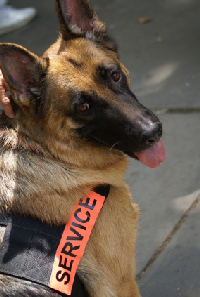
Showing posts with label Awareness. Show all posts

Monday, September 1, 2014

Canine Companions for Independence Spearheads Campaign to Stop Service Dog Fraud

 Take the Pledge to Stop Service Dog FraudOver the years I have published many articles highlighting the damage done by people passing off dogs as service dogs when they are not. Last year Canine Companions for Independence introduced their  pledge to stop service dog fraud and got 17, 500 people to take the pledge; this year their goal is to get 50, 000 people to sign on. I have signed on as someone who has personally experienced access denials and additional scrutiny because people fraudulently passed a non-service dog off as one.It is my sincere hope that as a person reading this blog you will educate yourself and take the pledge protecting the hard fought access right for legitimate service dog teams Take the Pledge

Learn More About The Problem of Service Dog Fraud

Thursday, May 1, 2014

May: Better Speech and Hearing Month; Hearing Dogs Lend an Ear

Hearing dogs alert people who are Deaf or severely hearing impaired to sounds in their environment that the human partners needs to know about for safety and to better function in the world. Hearing dogs can be trained to alert to everything from doorbells, alarm clocks, babies crying, home appliance noises, someone calling the handlers name,  and more. Hearing dogs unique in the service dog world as they are often both rescued/shelter dogs and small dog breeds. Historically Hearing dogs rearly worked outside the home, so issues that might have prevent a rescued dog from becoming a service dog weren't as big a concern. Today, you will still find that hearing dogs are still on the smaller side many hearing dogs are specifically breed for the work with known histories and temperaments that can handle a public life.

Standards for Hearing Dogs

Training Standards for Hearing Dogs

What Can Hearing Dogs do for their Owners?

Hearing Dogs Task List (Scroll half way down the page)

Programs Training Hearing Dogs

Dogs for the Deaf- Oregon Based places Nationwide

 The Hearing Dog Program- California based appears to place in western U.S.

Canine Companions for Independence- several regional facilities places Nationwide 

Golden Ears- Tandem Training Program Washington based (What is Tandem Training?)

Resources on Training Hearing Dogs

Book: Lend Me an Ear

Summary: An exciting book on a fascinating subject! Includes Hearing Dog Basics, Behind the Hearing Dog Temperament, Testing Potential Hearing Dogs, and Training Basics. More about Martha Hoffman the author.

Friday, March 30, 2012

April is Autism Awareness Month 2012: Service Dogs and Autism

While looking for the latest and greatest information on Autism and Service Dogs I stumbled across this post Another Fleecing of the Autism Community, Service Dog Edition about a now defunct program that took advantage of families with children on the spectrum. A problem that is sadly too common in my opinion, because it is very easy to get people to open their wallets for anything that might help these beautiful children and their families are often desperate to find anything that might help their child. More interesting than the article itself to me was a comment posted in response by Patty Dobbs of North Star Foundation,
" I want to mention that Siberian huskies are not a good choice for a child with autism, as their breeding does not lend them the necessary qualities to help them relate and communicate gently with a child on the autism spectrum. (Golden retrievers are much better suited to this work temperamentally...we breed several sound lines of Goldens that are superior temperamentally for work with children with autism.)
There is great danger in this field if children with autism are partnered with a dog that does not have the correct temperament to work with them...improper or nonexistent socialization of the dog slated for service work is also dangerous for the child. This is a service rich field, and it is not just about the training a dog receives or the facility they grow up within to keep the placement safe as well as effective."
This comment started me off on looking for articles providing food for thought for families with members living on the autism spectrum.

Food for Thought on Autism Service Dogs

In Service Dogs and Autism, world renowned Autism and Animals advocate Temple Grandin says,
"The use of service, or assistance, dogs with spectrum children is gaining popularity. However, this is a complicated issue. Unlike other autism interventions that can be more easily started and stopped, embarking on the journey to find an appropriate service dog for a child is a long-term commitment on the part of the entire family. A service dog is much more than a well-trained pet."
She goes on to discuss the sensory issues that come with dogs that may turn a child with autism off to a service dog and the different levels of support dogs can be trained to provide families and children on the spectrum. As a follow up piece to this one Temple wrote Questions to Ask When Selecting a Service Dog Provider, a good list of question for any family considering a service dog to use and think about what answer would be acceptable and not. 

In Service Dogs Aid People With Autism, Merope Pavlides, a  Certified Pet Dog Trainer and Certified Dog Behavior Consultant, as well as the mother of a son with autism discusses the common roles of a service dog placed with a child with autism and the pros and cons of such placements for families.


From The Thinking Person's Guide to Autism I found an Autism Service Dogs article 
by Sarah Oriel about her experiences in obtaining and working with a service dog for her son who has autism.  More can be found about her family's journey into the world of service dogs on her blog Planet Josh under the Paws and Effect .

From Service Dog Central, a cross disability community of service dog partners, their families and other allies Autism Service Dogs, multifaceted portal of information and issues surrounding service dogs for people with autism compiled by the members of the community living on or with someone who is on the autism spectrum.

Wednesday, March 7, 2012

Upcoming Teleconference: No pets allowed: Service Animals and Post Secondary Institutions

March 20, 2012»No pets allowed: Service Animals and Post Secondary Institutions

Time: 11:00a.m. -12:30p.m. PST

Recent revisions to the regulations implementing Title II and III of the ADA have raised increased focus on the issue of service animals in a variety of settings. Post secondary institutions face unique challenges around these issues when it comes to their policies and procedures regarding service animals in student housing, classroom and public spaces. This session will explore the different scenarios that often play out in post secondary education and discuss the interplay between laws governing non-discrimination in housing versus equal access to programs and services. Join this panel of presenters for a discussion of the issues and engage with them in an interactive question and answer period.
Certificate of Attendance/ CEUs offered for those participating in the live teleconference for the following fees: 

For-Profit Entities

Single Session

  • Teleconference: $40.00
  • Real-time Text Captioning (via Elluminate Live Platform): Free
  • Real-time Streaming Audio (via Elluminate Live Platform): Free

Not-for-Profit Entities

The non-profit discount is available to education, government and service agencies operating on a not-for-profit status.

Single Session

  • Teleconference: $25.00
  • Real-time Text Captioning (via Elluminate Live Platform): Free
  • Real-time Streaming Audio (via Elluminate Live Platform): Free

Friday, March 2, 2012

News: Puppies too frisky for ADA shelter - Lexology

A Burger King franchise was sued recently for violating the Americans with Disabilities Act (ADA) when an owner and his service dog-in-training were asked to leave the restaurant. A federal district court in California sided with Burger King and dismissed the case in the last few weeks. The court focused on whether the puppy, a 13-week-old Great Dane named Barack, was actually a service dog under the ADA. [ . . . Section Explaining what a service dog is under the law. . . ]
The restaurant asserted that Barack the Great Dane puppy was not fully trained as a service animal and only had basic obedience training. His owner, who was training the puppy to assist him with walking and balancing, countered that the puppy had a service dog tag from the county that was issued prior to the restaurant visit. The restaurant provided expert testimony that the puppy still had a “playful streak” and was too young to have complete control over its bladder and bowels for extended training periods.
However, the court focused on the fact that although the owner stated that the puppy was being trained to assist him with walking and balance, the puppy was not large enough at that point to assist with walking and balancing. According to the restaurant’s expert, the owner could have actually injured himself and the puppy if he had leaned on the puppy for balance. The court found that the puppy was not a service dog, because it had not been trained to perform tasks for the benefit of the individual with a disability, and the work or tasks performed by a service dog must be directly related to the individual’s disability. . . Although the Burger King case is an example that hospitality providers do not have to give unfettered access to customers with animals represented as service animals, they should exercise caution and common sense when encountering individuals with service animals. Read full Article Puppies too frisky for ADA shelter - Lexology

Tuesday, February 28, 2012

News: Justice Department settles Veterasn's ESA Discrimination Suit

Justice Department Settles Disability Discrimination Case Involving Disabled Veteran in Utah
WASHINGTON - The Justice Department today announced a $20,000 consent decree that resolves a lawsuit alleging that a Park City, Utah, condominium association and its management company violated the Fair Housing Act by refusing to grant a resident’s request for a reasonable accommodation.
The lawsuit, filed on Nov. 21, 2011, in U.S. District Court for the District of Utah, alleges that the Fox Point at Redstone Association, Property Management Systems and on-site property manager Derek Peterson refused to grant a reasonable accommodation so that Thomas Burton, a disabled combat veteran of the first Gulf War, could keep a small dog in the condominium he rented to help him cope with the effects of depression and anxiety disorder. The lawsuit further alleges that the defendants refused to waive their pet fees and insurance requirements and issued multiple fines that eventually led to the non-renewal of Burton’s lease. Read More

Friday, February 10, 2012

News:m American Bar Association Urges Policies to Accommodate Disabled Persons Using Service Animals

The American Bar Association adopted a resolution in support of policies being developed in support of the accommodation of people with disabilities who utilize services as a reasonable accommodation/ means of mitigating the affects of their disabilities.
RESOLVED, That the American Bar Association urges all federal, state, territorial, and local legislative bodies to repeal or amend all laws or policies inconsistent with the regulations implementing the Americans with Disabilities Act and to implement policies to ensure that persons with disabilities utilizing service animals are provided access to services, programs and activities of public entities and public accommodations in compliance with the regulations implementing the Americans with Disabilities Act in a manner that:
  1. Permits the use of a service animal for individuals with physical, sensory, psychiatric, intellectual, or other mental impairments;
  2. Provides an individualized determination of whether an animal meets the definition of service animal, recognizing that service animals do a wide range of work or tasks for individuals with disabilities;
  3. Provides for a size, weight and breed-neutral policy, utilizing a case-by-case analysis to determine whether a particular animal can be excluded from a public entity or public accommodation based on the particular’s animal’s actual behavior; and
  4. Encourages the enforcement by the United States Department of Justice and other governmental authorities with responsibility for implementing the Americans with Disabilities Act, in situations where individuals with disabilities utilizing service animals are denied access to services, programs and activities of public entities and public accommodations.
The supporting document for the resolution provides very clear and concise picture of the legalities supporting and defining service dogs as a concept in the United States complete with relevant case law and examples in just 4 pages of text. I highly recommend everyone have this in your files and personal knowledge bank!

Friday, January 27, 2012

News: Enforcing the ADA Report Service Animal Issues Featured

Settlement Under Title II of ADA
 "Title II, subtitle A, of the ADA prohibits discrimination on the basis of disability in all services, programs, and activities provided to the public by State and local governments, except public transportation services."

  • An individual with a disability complained that he was asked by a police officer to leave a California municipal park because he was accompanied by his service animal. The police department adopted, implemented, and publicly posted a service animal policy, conducted training on service animal issues for its employees, and provided information to residents on how to file ADA complaints.
Settlements Under Title III of ADA 
" Title III of the ADA, which prohibits discrimination on the basis of disability in "places of public accommodation" (businesses and non-profit agencies that serve the public) and "commercial facilities" (other businesses)."
  • An individual who uses a wheelchair complained that he, his wife and daughter, and friends were denied service at a South Carolina restaurant because he uses a service animal. The restaurant adopted and implemented a service animal policy, gave a copy of the policy to each employee, posted a notice welcoming service animals, and agreed to investigate and take steps to rectify any future complaints. They also compensated the complainant $500 and paid a $500 civil penalty. 
  • An individual who has myasthenia gravis complained that the outpatient center of a Maryland hospital refused to provide her scheduled medical services because she uses a service animal. The hospital agreed to adopt and implement a policy permitting service animals in its facilities and, in instances when a service animal cannot be in the room during a procedure (such as an MRI), the hospital will provide, at no cost to the patient, a bonded pet sitting service if the patient is unable to bring a companion to look after the service animal. The hospital also agreed to train staff on ADA requirements and compensate the complainant $5,000.
  • An individual who uses a service animal complained that a hotel in California refused to rent a room to her because of her service animal. The hotel agreed to adopt a service animal policy, post a disability nondiscrimination notice and a notice welcoming service animals in its reception area, in employee work areas, and on its website, train staff who have contact with guests and visitors on these policies, and pay the complainant $5,000.
  • An individual with a disability complained that a Tennessee hotel charged her a $10 pet fee because she uses a service animal. Although ownership of the hotel had changed since the complaint was filed, the new owner agreed to adopt a service animal policy, post the policy and a disability nondiscrimination notice in employee work areas, maintain records documenting new employees' receipt and acknowledgment of the policy, conduct staff training on the policy for all employees who have contact with guests, and post a sign welcoming service animals in the reception area.
  • An individual with a disability complained that a Florida resort attempted to charge him a pet fee because of his service animal. The resort adopted a policy welcoming service animals, modified its website and reservation materials to state that there is no charge for service animals, and posted signage regarding the new policy. 
  • An individual with a disability complained that she was denied access to a Texas medical practice because she uses a service animal. The practice agreed to adopt, implement, and post a policy welcoming service animals and train its staff on the policy. 
Mediated Cases
  • A couple complained that a California restaurant refused to serve them because one of them uses a service animal. The restaurant adopted a policy to serve customers who use service animals, developed employee training on the ADA's requirements for service animals, posted a sign indicating that service animals are welcome, and donated $3,200 to an advocacy organization.
  • In California, an individual with epilepsy complained that a Mexican restaurant refused her access because she uses a service animal. The restaurant agreed to serve customers with service animals at both of its locations, trained its staff on the ADA's requirements for service animals, posted signs welcoming service animals at the entrance of both restaurants, and gave the complainant two complimentary lunches.
Read Entire Report

Thursday, January 5, 2012

News: St. Mercy Medical Center settles violation of Section 504 of the Rehabilitation Act

Following an investigation by the U.S. Department of Health and Human Services (HHS) Office for Civil Rights (OCR), St. Edward Mercy Medical Center (Mercy), in Fort Smith, Arkansas has agreed to make changes to its policies and procedures to comply with Section 504 of the Rehabilitation Act of 1973 (Section 504).
The settlement resulted from a complaint filed with OCR by a person with a lumbar and spinal disability who requires a service animal to assist him in a number of daily functions, including carrying and picking up items and helping to stabilize his walking. While the complainant sought emergency medical treatment for his father, Mercy refused to allow the service animal to accompany the complainant into the hospital. The complainant was told his service animal was not a “seeing eye dog” and the animal would need to be removed from the hospital because he could not show vaccination records or tags verifying the health of the animal. After an investigation, OCR found that Mercy’s policies and procedures regarding access to service animals inappropriately excluded service animals already being used by qualified individuals with disabilities other than vision impairment. Read More

Tuesday, December 27, 2011

Motor Coaches (Bus) and The ADA

This is a respost because the answer to the question is so short and sweet:


Ask Project ACTION

“I am a motorcoach operator. I heard the Department of Justice (DOJ) has changed the definition of a service animal to include only dogs and in some cases, miniature horses. How does that change affect me?”
Answer: You are referring to a Final Rule issued by the DOJ that made a number of changes to their ADA regulations and became effective on March 15, 2011. For motorcoach operators there is no change in how you define service animals because you operate under regulations of the Department of Transportation (DOT). The definition of service animal found in 49 CFR 37.3 of the DOT ADA regulations has not changed and is not limited to a particular kind of animal.
Under 37.167(d) of the DOT ADA regulations, transit entities are required to permit service animals to accompany individuals with disabilities in vehicles and facilities. Service animals are individually trained to perform tasks for people with disabilities, such as guiding people who are blind or who have low vision, alerting people who are deaf, pulling wheelchairs, alerting a person who is having a seizure, or performing other special tasks. Service animals are working animals and not pets.
An operator may ask if an animal is a service animal or ask what tasks the animal has been trained to perform, but cannot require special ID cards or harnesses for the animal or ask about a person’s disability. Other passengers’ allergies and fear of animals are not valid reasons for denying access or refusing service to people with service animals.
Refer to the Federal Transit Administration “Technical Assistance Note (Word),” which aims to clarify that DOT regulations apply to the provision of transportation by public and private operators.
View related questions in our Frequently Asked Questions page.

Have a question?

Ask ProjectACTION by phone M-F 9:00 a.m. - 5:00 p.m. ET at 800-659-6428 or by email.


Tuesday, September 20, 2011

News:Social Security guard faces arrest in fracas over service dog  


The Atlanta Journal-Constitution
Melissa McMann, who is visually impaired, recalls minor incidents in which people challenged her about her service dog, but nothing like what happened last week with a security guard at a Social Security Administration office in Winder.
A security guard at a Social Security office faces charges after he's accused of trying to forcibly remove Melissa McMann, who is visually impaired, from the building because she had her service dog with her.
Manuel Bojorquez, Channel 2 Action News A security guard at a Social Security office faces charges after he's accused of trying to forcibly remove Melissa McMann, who is visually impaired, from the building because she had her service dog with her. Read more:Social Security guard faces arrest in fracas over service dog | ajc.com

Tuesday, August 16, 2011

Bark Magazine Covers Service Dog Fraud


Service Vest Controversy
EBay listing causes anger
A listing on eBay for a vest similar to this one ignited a controversy.
No matter what you want to buy, eBay probably has it. Looking for an 1897 Pocket Kodak camera? What about a gold-plated mango fork? Or perhaps you seek a service dog vest about which the seller says, “Use this for your good puppy and take her shopping with you. May have to play blind or stupid, but you love your puppy.”
This listing, which is no longer up, angered many people. Those with disabilities or whose family members have disablities are offended by the suggestion that people should dishonestly claim that their pets are service dogs, when they are not specifically trained in that way. They are concerned about the harm this causes to people with disabilities. The legitimacy of all service animals comes into question when people try to pass off their dogs as service animals. Read More

Unethical or Responsible Pet Care?
Playing service dog to travel first class.
The legitimacy and training of service dogs has come up a lot recently, and many of the cases do not have clear solutions. But what about when someone is consciously taking advantage of the privileges granted to service dogs?
With the USDAA Cynosport World Games coming up in Scottsdale, Ariz., I’ve been talking to many of the local competitors about how they’re traveling with their dogs. Some are caravanning in their RVs and others are reluctantly putting their pups in cargo. 
One of the more seasoned competitors mentioned that while she dutifully puts her dogs in cargo, she always sees fellow competitors passing their pups off as service dogs on the plane. Read More

Monday, August 8, 2011

Happy International Assistance Dog Week!

Happy International Assistance Dog Week! All this week events  are taking place globally to celebrate the work assistance/service dogs and educate people about what a service dog does. The Willamette Valley Assistance Dog Club is celebrating with a Facebook post-a-thon and community information tables.

Friday, August 5, 2011

News: Guide Dogs Encounter Blind Spot

China Daily
There are 13 million blind people in China, but only 34 guide dogs. China Daily has a report today on how difficult it is for these guide dogs to do their job in China. The article mostly talks about a woman in Beijing named Chen Yan who has been barred six times from taking her dog on the subway near her house. She's also been shooed away from restaurants, airplanes, and restaurants, - even McDonalds. Apparently this is quite a common issue.
The problem is that guide dogs are so new in China that a lot of businesses and services just don't know how to deal with them.
China's Protection Law for Disabled Persons does say that dogs can work in public places �C as long as they abide by local regulations. And that little "local" stipulation means that lots of places CAN refuse entry to guide dogs.
There are some places where they can't. Shanghai, Shenzhen, and Zhejiang province all have regulations that say guide dogs must be allowed into any workplace, museum, cinema, hospital or other public facility. Read More

Friday, June 17, 2011

News: DOJ Status Report on Enforcing the ADA Released

The Department of Justice (DOJ) recently released a status report detailing their efforts to enforce Americans with Disabilities Act (ADA). In this report there are 14 instances involving the denial of access to services or discrimination against a  person with a disability because they were accompanied by a service animal (dog) during a period from July 2010- September 2010.

  1. On July 19, 2010, the U.S. District Court for the District of Nebraska entered a consent decree resolving a simultaneously filed lawsuit against QuikTrip Corporation, a company that owns and operates more than 550 gas stations, convenience stores, travel centers, and truck stops in the Midwest, South, and Southwestern United States. Under the terms of the decree, QuikTrip will remove barriers over a three year period at its current stores to achieve compliance with ADA accessibility requirements; ensure that at least two gas dispensers at current stores and all gas dispensers at future stores are accessible to individuals with disabilities, including the dispenser controls, self-service payment mechanisms, and call buttons for customers who need assistance; adopt, implement, and train store employees on policies for providing refueling and other types of assistance for people with disabilities, serving people who use service animals, and maintaining accessible features, such as accessible parking and routes; upgrade and maintain call buttons for customers with disabilities requesting assistance; and implement and maintain an ADA comment line and a complaint resolution process to resolve ADA-related complaints received from customers. QuikTrip will also design and construct future stores to comply with ADA accessibility requirements and will make its website accessible. In addition, QuikTrip will create a $1.5 million compensatory damages fund for individuals who were victims of discrimination and will pay a civil penalty in the amount of $55,000.
  2. On July 14, 2010, the owner and operator of the Sheraton Grand Sacramento Hotel in Sacramento, California, entered into a settlement agreement resolving a complaint by a hotel guest with a disability who was required to pay a pet deposit and was assigned to the pet floor because she was accompanied by her service animal. In the settlement, the hotel agreed to adopt an ADA-compliant service animal policy, write to 33 other Sheraton hotels around the country encouraging them to ensure equal access for guests with disabilities who use service animals, and pay $500 in compensatory damages to the complainant.
  3. On July 19, 2010, Blockbuster, Inc., entered into a settlement agreement with the Department resolving a complaint filed by an individual with a disability who was denied access on multiple occasions at different Blockbuster stores when she attempted to shop while accompanied by a service animal, even after contacting Blockbuster, Inc., and receiving assurances that she would be allowed to shop at Blockbuster stores with her service animal. The agreement requires Blockbuster to adopt and implement a comprehensive service animal policy, provide training to employees at more than 3,000 retail stores throughout the United States about the policy, post its service animal policy and signs welcoming service animals in each of its stores, and establish a toll-free number and a grievance procedure for resolving ADA complaints from customers. Blockbuster will also pay $12,000 in compensatory damages to the complainant and a $10,000 civil penalty to the United States.
  4. On September 10, 2010, the American Hospitality Inn in Portland, Oregon, entered into a settlement agreement with the Department resolving a complaint from a man who is blind who, when registering for a room at the hotel, produced a state issued identification card and a Veteran's Administration identification card but was turned away because he did not have a driver's license for identification. Under the terms of the settlement, the hotel will adopt a formal policy on acceptable forms of identification as well as a service animal policy. The hotel will also pay $1000 in compensatory damages to the complainant.
  5. An individual with congenital heart failure complained that a New Jersey medical clinic refused to allow her into the clinic because she uses a service animal. The clinic adopted a service animal policy, posted signs welcoming service animals, and trained its employees about the policy.
  6. An individual with a disability who uses a wheelchair complained that an Indiana hotel refused her service because she uses a service animal. The hotel adopted a service animal policy, posted the policy in a conspicuous location, and trained staff on the policy.
  7. An individual who is deaf and uses a service animal complained that a Tennessee hotel asked him to leave because of the hotel's no pet policy. The hotel agreed to adopt a service animal policy, post information for guests about the policy, train employees about the policy, and provide information to guests about filing an ADA complaint. The hotel also agreed to pay the complainant $750.
  8. An individual who is blind complained that a Texas convenience store refused to serve him because he uses a service animal. The store agreed to adopt a service animal policy, post signs informing customers about the policy, train employees about the policy, and pay the complainant $1,500
  9. An individual with a mobility disability who uses a service animal complained that a chain motel in Arizona refused to serve him. The motel agreed to adopt a service animal policy, post signs informing customers about the policy, and train employees about the policy.
  10. An individual with a disability alleged that a New Jersey medical facility refused to serve him because he uses a service animal. The facility agreed to adopt a service animal policy, train all current and new employees on the policy, post the policy in all of its locations where patients are served, and pay the complainant $1,000.
  11. An individual who is blind and uses a service animal complained that the manager of a Dallas retail store asked him to leave because of concerns that his service animal would damage store merchandise. The store agreed to adopt a service animal policy, post signs informing customers about the policy, train employees about the policy, and pay the complainant $1,500.
  12. In Florida, a woman with multiple sclerosis alleged that a restaurant refused to serve her and her husband inside the restaurant because she uses a service animal for balance. The owner offered to serve them in an alley adjacent to the restaurant and, when they refused, insulted them, asked them to leave, and ultimately escorted them out of the building. The restaurant adopted a policy to allow patrons who use service animals to enter and be served in the restaurant, informed employees about the policy, and posted signage indicating that service animals are welcome in the restaurant.
  13. An individual with low vision who uses a service animal complained that a California restaurant refused to serve him. The restaurant changed its policy and agreed to serve customers who use service animals, developed employee training on service animals and the ADA, made a $500 donation to a service animal organization, and issued an apology letter to the complainant's family who was with him when the incident occurred.
  14. In New Jersey, a woman who uses a wheelchair complained that the manager of a chain restaurant harassed her and asked her to leave because she uses a service animal for mobility assistance. The national chain changed its policy and agreed to serve customers who use service animals, circulated an article on the updated policy through an internal corporate publication for employees, and trained all employees on the ADA. The chain also posted signs welcoming service animals at each restaurant's entrance. In addition, the manager who asked the complainant to leave sent her an apology letter, and the chain donated $1,000 in the complainant's name to a service animal organization and gave her two $50 gift certificates. 
 To read synopsis of other cases visit http://www.ada.gov/julysep10.htm here you can also access full case documents.

Thursday, June 16, 2011

Cabbies arrested after refusing blind passenger | WTNH.com Connecitcut

Windsor Locks, Conn (WTNH) - State police have arrested two taxi cab drivers at Bradley International Airport for allegedly refusing to accept a blind man and his service dog as a paying fare, and then refusing to leave the taxi cab line at the airport.Read More

Wednesday, May 18, 2011

Internet in an Uproar over Service Dog Fraud

Service dog fraud is becoming a bigger problem

Service dogs are invaluable companions to people with disabilities.  These trained animals guide blind people across the street, keep children with autism from wandering away, help provide support for those with problems walking, etc. But according to this article from The Seattle Times more and more pet owners are committing service dog fraud.  These owners are buying certificates, vests and identification numbers online so that their dogs can accompany them into public places such as stores and restaurants, travel with them free on planes, trains or buses or live in restricted housing. Read more

News, Information and Ideas on how to deal with hearing loss in a hearing world. Plus a few other topics!

Article in USA Today on 'Fake' Service Dogs

Believe it or not, this is becoming a real problem!  I've written other articles on this and even gotten some emails from readers with service dogs asking me to take them down due to their not agreeing with my opinions.  But, the fact is, there are people out there that are taking advantage of the laws/rules for those with true needs for a genuine service dog.
Unfortunately, the ADA law states that a business owner cannot question or require proof that a dog is really a service dog.  It's against the law.  So, the ones that are perpetuating this fraud are getting by with it all in the name of keeping their little darling with them where ever they choose to go.  Until the websites that sell these service dog vests start doing the right thing and require some sort of proof that the dog really is a service dog, the fraud will continue. Read More

Is That a Real Hearing Dog?

Abuse of the Americans with Disabilities Act provisions concerning service dogs is increasing. People are buying fake service dog vests and certifications, and insisting on the right to take their non-service dog pets into stores et al with them. The Department of Justice recently updated Title II regulations on service animals to say that a public entity may ask just two questions regarding service animals: is it needed for a disability and what does the dog do? Documentation is not required.
In my opinion, that makes it rather easy for people who want to pass off their pets as service dogs, to lie. If I am interpreting the DOJ language correctly, it means that all a hearing person has to do is say "My dog is a hearing dog. My dog alerts me to noises that I can not hear." Behavior is apparently the only clue that a dog is or is not a service dog. Real trained service dogs know how to behave.Read More
They’re the ire of legitimate service dog owners and they’re also guilty of fraud.

Pet Owners Who Skirt Rules With Fake Service Dogs Are Committing Fraud

 They’re pet owners who pass their animals off as service dogs by using phony credentials which in turn allows their pets to live in restricted housing, accompany them inside restaurants and hotels or fly for free in airplane cabins rather than in cargo holds
“I don’t want to say it’s a scam, but it is a scam,” said Nick Kutsukos, 72, who runs Elite K9 Academy in Jupiter, Fla., and has trained service dogs for 40 years.Read more


Monday, May 16, 2011

Shilo Shines in More Than Disability Video

Shilo and I recently assisted a UO Journalism student with a class project.  The video Shilo and I working together.
More than a Disability from Ethos Magazine on Vimeo.