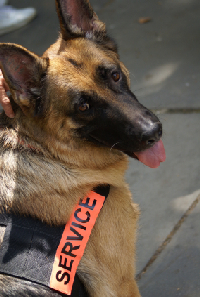
Showing posts sorted by date for query service dog fraud. Sort by relevance Show all posts

Monday, September 1, 2014

Canine Companions for Independence Spearheads Campaign to Stop Service Dog Fraud

 Take the Pledge to Stop Service Dog FraudOver the years I have published many articles highlighting the damage done by people passing off dogs as service dogs when they are not. Last year Canine Companions for Independence introduced their  pledge to stop service dog fraud and got 17, 500 people to take the pledge; this year their goal is to get 50, 000 people to sign on. I have signed on as someone who has personally experienced access denials and additional scrutiny because people fraudulently passed a non-service dog off as one.It is my sincere hope that as a person reading this blog you will educate yourself and take the pledge protecting the hard fought access right for legitimate service dog teams Take the Pledge

Learn More About The Problem of Service Dog Fraud

Sunday, July 28, 2013

Wired Magazine Article Encourages Service Dog Fraud


A reader brought to my attention this week  that Wired Magazine published an article, The Cheat Code to Life, encourage their readers to pass off their pets as service dogs to gain entry to places and avoid fees. 
BRING MR. FLUFFY ANYWHERE: SERVICE DOG VEST ($33) 
Make every day Take Your Dog to Work Day and go everywhere—the coffee shop, the grocery store! How? Simply dress him in a vest that just happens to be bright orange and slap on a “Service Dog” patch. VIP status: confirmed.
My response: "I can't believe Wired Magazine is so desperate for content that your editorial team has decided that encouraging people to commit federal fraud by claiming that they qualify as a person with a disability under the ADA and that their dog is a service dog under the definition found in the same law. As a person living with a disability who has worked service dogs for over 12 years and has to deal with aggressive dogs, unhousebroken dogs, and off leash dogs in public all being passed off as service dogs causing  the community of legitimate service dog experience additional requirements such as current letters of medical necessity for people experiencing psychiatric disabilities to fly, the necessity to add to the definition that a service dog must be unhousebroken, under control, not aggressive and more. I urge Wired readers and editorial staff to consider the damage passing off their dog as a service dog does to people who require the assistance of a service dog to live their life considering legitimate and legal ways they can ask for their dog to accompany them and avoid fees such as developing a pet resume for them, or simply asking permission from the business they wish to enter. For a more on how serious the effects of service dog fraud have on the service dog user community visit http://servicedogsawayoflife.blogspot.com/search/label/community%20issues.
Sincerely,
Melissa Mitchell
Service Dogs a Way of Life

Tuesday, August 16, 2011

Bark Magazine Covers Service Dog Fraud


Service Vest Controversy
EBay listing causes anger
A listing on eBay for a vest similar to this one ignited a controversy.
No matter what you want to buy, eBay probably has it. Looking for an 1897 Pocket Kodak camera? What about a gold-plated mango fork? Or perhaps you seek a service dog vest about which the seller says, “Use this for your good puppy and take her shopping with you. May have to play blind or stupid, but you love your puppy.”
This listing, which is no longer up, angered many people. Those with disabilities or whose family members have disablities are offended by the suggestion that people should dishonestly claim that their pets are service dogs, when they are not specifically trained in that way. They are concerned about the harm this causes to people with disabilities. The legitimacy of all service animals comes into question when people try to pass off their dogs as service animals. Read More

Unethical or Responsible Pet Care?
Playing service dog to travel first class.
The legitimacy and training of service dogs has come up a lot recently, and many of the cases do not have clear solutions. But what about when someone is consciously taking advantage of the privileges granted to service dogs?
With the USDAA Cynosport World Games coming up in Scottsdale, Ariz., I’ve been talking to many of the local competitors about how they’re traveling with their dogs. Some are caravanning in their RVs and others are reluctantly putting their pups in cargo. 
One of the more seasoned competitors mentioned that while she dutifully puts her dogs in cargo, she always sees fellow competitors passing their pups off as service dogs on the plane. Read More

Wednesday, May 18, 2011

Internet in an Uproar over Service Dog Fraud

Service dog fraud is becoming a bigger problem

Service dogs are invaluable companions to people with disabilities.  These trained animals guide blind people across the street, keep children with autism from wandering away, help provide support for those with problems walking, etc. But according to this article from The Seattle Times more and more pet owners are committing service dog fraud.  These owners are buying certificates, vests and identification numbers online so that their dogs can accompany them into public places such as stores and restaurants, travel with them free on planes, trains or buses or live in restricted housing. Read more

News, Information and Ideas on how to deal with hearing loss in a hearing world. Plus a few other topics!

Article in USA Today on 'Fake' Service Dogs

Believe it or not, this is becoming a real problem!  I've written other articles on this and even gotten some emails from readers with service dogs asking me to take them down due to their not agreeing with my opinions.  But, the fact is, there are people out there that are taking advantage of the laws/rules for those with true needs for a genuine service dog.
Unfortunately, the ADA law states that a business owner cannot question or require proof that a dog is really a service dog.  It's against the law.  So, the ones that are perpetuating this fraud are getting by with it all in the name of keeping their little darling with them where ever they choose to go.  Until the websites that sell these service dog vests start doing the right thing and require some sort of proof that the dog really is a service dog, the fraud will continue. Read More

Is That a Real Hearing Dog?

Abuse of the Americans with Disabilities Act provisions concerning service dogs is increasing. People are buying fake service dog vests and certifications, and insisting on the right to take their non-service dog pets into stores et al with them. The Department of Justice recently updated Title II regulations on service animals to say that a public entity may ask just two questions regarding service animals: is it needed for a disability and what does the dog do? Documentation is not required.
In my opinion, that makes it rather easy for people who want to pass off their pets as service dogs, to lie. If I am interpreting the DOJ language correctly, it means that all a hearing person has to do is say "My dog is a hearing dog. My dog alerts me to noises that I can not hear." Behavior is apparently the only clue that a dog is or is not a service dog. Real trained service dogs know how to behave.Read More
They’re the ire of legitimate service dog owners and they’re also guilty of fraud.

Pet Owners Who Skirt Rules With Fake Service Dogs Are Committing Fraud

 They’re pet owners who pass their animals off as service dogs by using phony credentials which in turn allows their pets to live in restricted housing, accompany them inside restaurants and hotels or fly for free in airplane cabins rather than in cargo holds
“I don’t want to say it’s a scam, but it is a scam,” said Nick Kutsukos, 72, who runs Elite K9 Academy in Jupiter, Fla., and has trained service dogs for 40 years.Read more


Thursday, February 24, 2011

News: Leapin' Lizards! Service Animals Are Multiplying Like Doggone Rabbits Skippy the Iguana Keeps His Owner Calm, But Therapy Dog Maxx Is an Impostor

Rhonda Kimmel's 11-year-old West Highland terrier, Maxx, goes with her everywhere—to the mall, restaurants and even to the bank.
Cosmie Silfa relies on an unusual companion to help him stay clean and sober: Skippy, a four-year-old iguana. But changes to the Americans with Disabilities Act could decertify Skippy as an official service animal. WSJ's Clare Major reports.

What gives Maxx entree to places normally off-limits to canines and other animals is the embroidered, purple vest he sports. It says: "Therapy Dog Maxx."
Maxx is a lot of things, including well-behaved, and he is a faithful companion. What he is not, however, is a therapy dog or a service dog, and Ms. Kimmel is not disabled. Read More

Other SDAWL Articles on fake Service dogs/ fraud:

Monday, January 31, 2011

Commentary: Certification- A Myth in The USA

When I read this "GOLIATH is a five pound black Chihuahua, Department of Animal Services certified Assistance dog with a Canine Good Citizen Award from the American Kennel Club in Washington D.C." (from Dastardly Landlord Evicts Five Pound Service Dog On Christmas Day) I decided that this topic was beyond ripe for commentary.
There is no requirement in the ADA that a service dog be certified and there is no such thing as a national certification in the USA- period. Meaning there is no:
  • Nationally recognized, standardized test that dog and partner must pass in order to a service dog in the USA. 
  • Agreed upon industry set of behaviors or cues beyond those of standard obedience that a service dog must know
  • Standardized set of documentation that a person with a disability utilizing a service dog must have or be able to obtain before having a service dog
  • Requirement that a service dog team be registered in any database (hint these are money making schemes)
  • Requirement that a team have and or show any special ID, collar tags, leashes, harness or any other identifying articles
What does exist and always has since the term service animal found its way into our legal history in 1990 is a for an animal to be a service animal are requirement that the animal be trained(note the past tense here- service dog candidates, potentials or otherwise still in training hoping one day to be a service dog are not covered in the ADA definition of a service animal) to perform tasks to mitigate a person's disability and that the person meet the definition of a person with a disability as defined under the ADA also. What also exists are dog teams that are trained, placed and supported by programs staffed by people skilled in training and assessing both people with disabilities for the appropriateness of a service dog assistant and training/placing potential service dogs with the needed skills. So why does this myth of certification persist?


The United States has taken the procedural/ legal route to providing protections and rights to certain classes of people. People must go through (or be prepared to go through) certain processes to prove they meet the definition of a protected class or person entitle to certain rights. Service dogs are a tool utilized by some people with disabilities as a method of accommodating a disability allowing the person to better access public spaces and services. When the idea of service dogs first took hold in the U.S. following WWI with the introduction of dog guides for people who where blind all of these teams were trained and matched by the dog guide programs. These teams worked hard over the next decades to prove that they and their dogs were safe and non-disruptive in public while showing the general public what a capable person with a disability and a highly trained, well cared for dog can accomplish together. The program model with experienced trainers, veterinarians, and skilled disability service providers became what people associated with service dogs. As the industry expanded the types of disabilities a dog could be trained to assist with and the number of programs training them blossomed. Programs are only capable of training and placing dogs for people with disabilities meeting the skills that the trainers know how to train dogs for and have the time to train while trying to meet the needs of those already waiting. The demand for service dogs far exceeds the ability of the system to supply the with the average wait time somewhere between 2.5 and 5years. So some people with disabilities who could possibly benefit from the assistance of a service dog cannot  find a program with the time/resources to train a dog for them. Still others could get a dog from a program but can't fathom waiting for five years for help.

The assumption that certification exists extends from the procedural/ laws based cultural approach to providing accommodations/assistance to people with disabilities in the U.S. This approach says that only people who meet certain legal definitions and thresholds get accommodation and in order to get them they must prove (or be able to) that the meet the legal definition to request accommodations and that those accommodations are reasonable. This idea is contradicted by the idea that people should not have to prove who they are to have their civil rights. People with disabilities are allowed to use assistive equipment their need to mitigate their disabilities in the public sphere and are not required to have ID, papers, or be in some database to use them.  As with every other part of the ADA in order to enforce it or prove a violation one must file suit in a court of law. It is of course illegal to claim to be something you are not; it's called fraud. However, this is also something to be decided by the courts.
This does not mean we as a public and service dog teams are without any recourse. The DOJ has established Three questions that business owners and their staff may ask and supports a business owners right to ask that any service animal whose behavior presents a threat or whose behavior is not under proper control of the handler with a disability. Also, many places have ordinances meant to protect people from animals who are display dangerous behaviors or are not under control  of their owners. These laws apply to service dogs also. Just because a dog may be a service dog does not give it a free pass to bark, growl or bite people or other animals. Those of us who want to see the right of public access for people with disabilities maintained need to continue to work hard to show the public and businesses what a properly behaved and trained team behaves like and help them to understand that they too have rights. ID cards, vests, and patches are not what make a dog a service dog, anyone with a connection to the internet can get these. What makes a dog a service dog is health, the proper temperament, hundreds if not thousands of hours of training, and being partnered with a person with a disability protected under ADA who they assist.
Moral of the story anyone can buy and ID and a vest or pay for a piece of paper these are not your safeguards against poorly behaved animals, neither is trying to disallow every dog. Businesses and their staff must use common sense and speak up when a team is causing disturbances through more than just being there. A true handler will address their service dog's behavior. As we must ensure our service dog is as unobtrusive as possible... hearing the phrases:
"I didn't know a dog was here!"
"Did you see what that dog did to help him/her? It was wonderful/amazing!"
"I wish my dog was so [insert good, quiet, well behaved here]"
"Your dog is so well behaved!"
"Your dog is so well [insert cared for, clean, or well groomed here]"
Should make your day and tell you you've done it right! 

Tuesday, March 30, 2010

Press Release:WORKING SERVICE DOGS GET FREE VETERINARY EYE EXAMS

Please note this event is for Service Dogs placed by programs only  because 
"Over the past several years we have had some individuals claim their dog was a Service Dog just to take advantage of the eye exam.  ACVO Diplomates generously donate their time and resources to provide eye exams for Service Dogs.  These resources are limited and if nonqualified dogs fill the limited time slots allotted then a qualified dog may be excluded. "
(Yet another example of how service dog fraud hurts legitimate owner -trained service dogs and their partners. Stepping off my soap box now.)

Press Release:
Certified working service dogs are being offered free screening eye examinations through Eye Care for Animals for the entire month of May. This is the third year this event has been held nationally by the American College of Veterinary Ophthalmologists ® in association with boarded veterinary ophthalmologists. 

Screening eye examinations can detect ocular diseases at an early stage when treatment can be most successful, thereby helping preserve the sight of these dogs whose partners depend upon them. Certified working service dogs include guide dogs, handicapped assistance dogs, detection dogs, and search and rescue dogs.

Qualified participants must register online at www.acvoeyeexam.org.  Click on Dog owners/participants at the top of the page and follow the onscreen instructions.  Once the registration number for the dog is assigned, the participant may call the participating Eye Care for Animals in their area to schedule an appointment for their dogs free eye exam during the month of May. Appointments are limited, so register and call today!

Eye Care for Animals has facilities in Arizona, California, Illinois, Kansas, Maryland, Nevada, New Mexico, Ohio, Texas, Utah, Virginia and Wisconsin, and is dedicated to providing the finest in veterinary ophthalmology services.  Their staff of board certified ophthalmologists provides the highest level of care, education, and understanding to their clients and their animal companions.  For more information visit www.eyecareforanimals.com.

ACVO® is a veterinary specialty organization of the American Board of Veterinary Specialties.  Its mission is to advance the quality of veterinary medicine through certification of veterinarians who demonstrate excellence as specialist in veterinary ophthalmology.  To become board certified a candidate must complete their Doctor of Veterinary Medicine program, a one year internship, a three year residency and pass a series of credentials and examinations.

Contact:
Julie Gamarano
jgamarano@eyecareforanimals.com
3260 N Hayden Road, Suite 214
Scottsdale, Arizona 85251
P: 480-682-6911

Thursday, November 13, 2008

News:Trimet Board Member Suggests Punishing all Service Dogs Over the Actions of a Fraud

Trimet Board Member Lynn Lehrback suggests that Trimet require all dogs on transit to be muzzled. While I agree with Lehrback what happened to that Pomeranian was horrific, people with legitimate service dogs should not pay for the sins of people pretending their dogs are service dogs. A muzzle may seem like an easy and simple guarantee that something like this will never happen on Trimet again; however, a muzzle would effective render many service dogs partnered with people with physical disabilities useless. The tasks of retrieving dropped items, opening/closing doors, carrying items, helping people adjust their bodies and more require a service dog to have full use of their mouths. Furthermore, the process of putting on and removing a muzzle would be impossible for people whose disabilities affect hand function. Many of the modifications made to gear for such people would make a muzzle and easily removed puzzle for these smart, problem solving dogs. Trimet and its managers seem to be unaware of the power they have to expose people passing off their pets as service dogs by simply asking three questions according to the DOJ Business Brief:
1. Are you a person with a disability? (though they may not enquire as to the exact nature of the disability)
2. Is that a service animal?
3. What tasks has the animal been trained to perform?

Even if an animal is a legitimate service dog it may be denied access if (1) the animal is out of control and the animal's owner does not take effective action to control it (for example, a dog that barks repeatedly during a movie) or (2) the animal poses a direct threat to the health or safety of others.

Before taking people's independence and punishing innocent dogs, I encourage Trimet and its board to educate their employees about the questions they can and should ask. I also encourage service dog partners to answer these questions as a matter of course and think of it as keeping yourself and your partner safe and able to work freely without worry if that dog is going to attack your service dog.

Monday, November 3, 2008

News: Backlash from dog killing on Portland Public Transit

Last week I wrote about the sad incident were a Pomeranian emotional support animal was killed by another none service dog while riding Trimet in Portland, Ore. Today, not one but two articles appear in reaction to the incident Service animal regulation is desperately needed and Take the menagerie off the bus Unfortunately, anyone could have easily predicted the backlash to such a horrific incident involving not one but two non-service dogs calling for national certification and spreading further misinformation.

In Service Animal Regulation Desperately needed the writer makes the following points that are not entirely true:

While it is true there are no federal standards for what training a dog must have to be a service dog, there are standards relating to the behavior of dogs in the community commonly referred to as local and federal animal control laws which if local authorities had the means and money to enforce properly would go a long way to keeping animals who pose a danger to people and other animals out of public spaces. Also, there are standards established by the Service Dog Community that establish minimum standards of behavior and training for service dogs in public. Recent the Department of Justice responded to those who would like to see national certification: "Some commenters proposed behavior or training standards for the Department to adopt in its revised regulation, not only to remain in keeping with the requirement for individual training, but also on the basis that without training standards the public has no way to differentiate between untrained pets and service animals. Because of the variety of individual training that a service animal can receive--from formal licensing at an academy to individual training on how to respond to the onset of medical conditions, such as seizures--the Department is not inclined to establish a standard that all service animals must meet. While the Department does not plan to change the current policy of no formal training or certification requirements, some of the behavioral standards that it has proposed actually relate to suitability for public access, such as being housebroken and under the control of its handler. " The DOJ then went on to "Expressly incorporate the Department’s policy interpretations as outlined in published technical assistance Commonly Asked Questions about Service Animals (1996) (http://www.ada.gov/qasrvc.htm) and ADA Business Brief: Service Animals (2002) (http://www.ada.gov/svcanimb.htm) and add that a public accommodation may ask an individual with a disability to remove a service animal from the premises if: (1) The animal is out of control and the animal’s owner does not take effective action to control it; (2) the animal is not housebroken or the animal’s presence or behavior fundamentally alters the nature of the service the public accommodation provides (e.g., repeated barking during a live performance); or (3) the animal poses a direct threat to the health or safety of others that cannot be eliminated by reasonable modifications. . ."

I would also like to shed some light on why, as I understand it after nearly 10 years as a member of the service dog partner community, the community has not created a national required certification for service dogs.

Outside of obedience the training through to the advanced level, the need to be completely non-agressive, dog traits the make a good service dog vary somewhat on the type of service a dog is trained to provide. There are many examples of the differences in behavior that is acceptable in one type of service dogs and not in another. The most commonly recognized type of service dog, Guide dogs, need to be extremely calm, and focus on the world directly in front of their and their human partner's immediate path. Dogs who have too much energy, want to retrieve everything, or who are too interested in other people may fail to be dog guide; however, some dogs who don't become guides may be picked up by other service dog organizations for the very same traits that caused them to not be suitable guide dogs.

Retrieving is the root skill for many mobility related service dog tasks including opening doors, retrieving drop items, and assisting people with dressing. A dog who has a lot of energy may not make a good guide or mobility dog may just make a great hearing dog. Hearing dogs must have a retrieving drive that they use to discover sounds and return to take their partner to the source of the sound. In a sense they are retrieving their partner and taking them to important sounds. They must also have the energy and drive to respond to sounds anytime day or night making dogs with higher energy reserves and needs attractive candidates. It would be difficult to establish a complete list of behaviors that may be appropriate for a service dog in every possible situation related to the person they are serving. For example many people believe that a dog is not well trained unless it walks in a perfect heel on its master's left side at all time. Does this mean a dog who walks nicely on the right due to its handlers needs is not appropriately trained? To some it might. Some dogs are trained to find the nearest person when their partner is in need of emergency help and, yet some people might say that this dog is not trained because it left its handler. Other dogs may emit a bark on cue to get emergency help and attention for their partner. Is this dog less trained?

There are still more issues involved in national certification including what entity would do the certifying? Would there be a fee associated with certifying and registering service animals? How would this fee affect people with disabilities ability to have the service dogs they need? How often would registered service dog teams need to re-certify to ensure task training and disability status are still met? Who would safeguard people private medical information? Do people really want people medical information to potentially become matters of public record? The issue of National certification is far from a simple thing.
The second article Take the menagerie off the bus blames the Department of Transportation for single handedly opening the door for untrained emotional support animals in public and giving them the same access rights as people with fully trained service dogs. This statement is mistaken on both points. Emotional Support Animals are only currently recognized in two sections of the law The Air Carrier Access and the Fair Housing Act. "'emotional support' animals that are covered under the Air Carrier Access Act, 49 U.S.C. 41705 et seq., and its implementing regulations. 14 CFR 382.7 et seq.; see also 68 FR 24874, 24877 (May 9, 2003) (discussing accommodation of service animals and emotional support animals on air transportation), and that qualify as "assistance animals" under the FHA, but do not qualify as "service animals" under the ADA, " according to the DOJ website. Neither of these regulations give people with emotional support animals the full public access rights guaranteed to people with disabilities covered by the ADA whose service dogs are trained to perform tasks to mitigate their disability.

For more information on the changes to the ADA regarding service dogs visit http://www.ada.gov/NPRM2008/titleiii.htm#toc_24.

Monday, September 22, 2008

People Claiming Their Dogs are Service Dogs to Take them in Public Beware

Everyday in the service dog community there are discussions of what to do about people who do not have disabilities passing their pets off as Service Dogs. Furthermore, just because a person happens to have a dog, does not automatically make the animal a service dog [See my previous post What is a Service Dog]. The combination of the presence of a disability, the fact that a dog can be trained to mitigate the effects of that disability, and the facts the animal has been individually trained to performs tasks that mitigate that disability are the key elements to defining whether or not a person and animal comprise a working service dog and are protected under the ADA. People buying service dog gear and passing off themselves and their pets as service animals are not only possibly committing federal fraud, they may also be breaking state and local laws. The definition of fraud according to Free Dictionary.com is :

fraud n. the intentional use of deceit, a trick or some dishonest means to deprive another of his/her/its money, property or a legal right. A party who has lost something due to fraud is entitled to file a lawsuit for damages against the party acting fraudulently, and the damages may include punitive damages as a punishment or public example due to the malicious nature of the fraud. Quite often there are several persons involved in a scheme to commit fraud and each and all may be liable for the total damages. Inherent in fraud is an unjust advantage over another which injures that person or entity. It includes failing to point out a known mistake in a contract or other writing (such as a deed), or not revealing a fact which he/she has a duty to communicate, such as a survey which shows there are only 10 acres of land being purchased and not 20 as originally understood. Constructive fraud can be proved by a showing of breach of legal duty (like using the trust funds held for another in an investment in one's own business) without direct proof of fraud or fraudulent intent. Extrinsic fraud occurs when deceit is employed to keep someone from exercising a right, such as a fair trial, by hiding evidence or misleading the opposing party in a lawsuit. (See: constructive fraud, extrinsic fraud, intrinsic fraud, fraud in the inducement, fraudulent conveyance) damages). For further reading on fraud see Fraud.

A person claiming their dog is a services dog may also be guilty of Impersonation which is defined as the "The crime of pretending to be another individual in order to deceive others and gain some advantage."

According to a an article in the San Diego Metro News pretending your dog is a service dog when it is not is punishable by up to six month in jail and a $1,000 fine. Dog Bite Law further defines this California statute.

Many people think they are doing no harm by allowing others to believe their pet is a service dog, au contraire, my dear readers. By actively claiming you are a person with a disability when you are not (this is in fact what these people are doing)you:
  • Belittle the daily difficulties people with disabilities live with
  • Confuse the public and business community as to the purpose of a service dog.
  • Trample on a business owner's right to know that the dogs coming in are well trained,healthy, safe and necessary to their valued customers.
  • Endanger people with disabilities with true service dogs, because while you may love your Fido the standard of health care for a service dog are much more stringent than for pets. If a Service dog gets sick, infested with fleas, or any number of common dog maladies, the service dog is less able to work.
  • Weaken the standards for dogs in public opening the doors for people with dogs who may be extremely fearful or aggressive and are prone to behaviors which endanger us all.
  • Force people with real health problems such as severe allergies to share space with animals who are not groomed and bathed regularly to keep allergens to a minimum.

So before you go out and buy (0r make) that vest, collar, or backpack. Think about the repercussions both legally and ethically. Business owners and their employees may ask three questions according to the DOJ Business Brief:

1. Are you a person with a disability? (though they may not enquire as to the exact nature of the disability)

2. Is that a service animal?

3. What tasks has the animal been trained to perform?

Even if an animal is a legitimate service dog it may be denied access if (1) the animal is out of control and the animal's owner does not take effective action to control it (for example, a dog that barks repeatedly during a movie) or (2) the animal poses a direct threat to the health or safety of others.

The most common reasons people pass their pets/dogs off as service animals are:

  • To gain access to a public place or service that does not normally allow pets (i.e. a store, restaurant, bus, train, plane)
  • To avoid paying the fees often associated with owning a pet or bring one with you (i.e. licence fees, transport fees, hotel pet fees)
  • To access services offered to those with service animals (i.e. reduced vet/groomer fees)
  • Because they can
Service dogs are not a perk of having a disability nor are they the latest fashion accessory. They are one of the many tools people with disabilities use to perform the everyday tasks of life just like wheelchairs, walkers, canes, medications, hearing aids, white canes and more.